
IIMs Courses
India's MBA Discovery
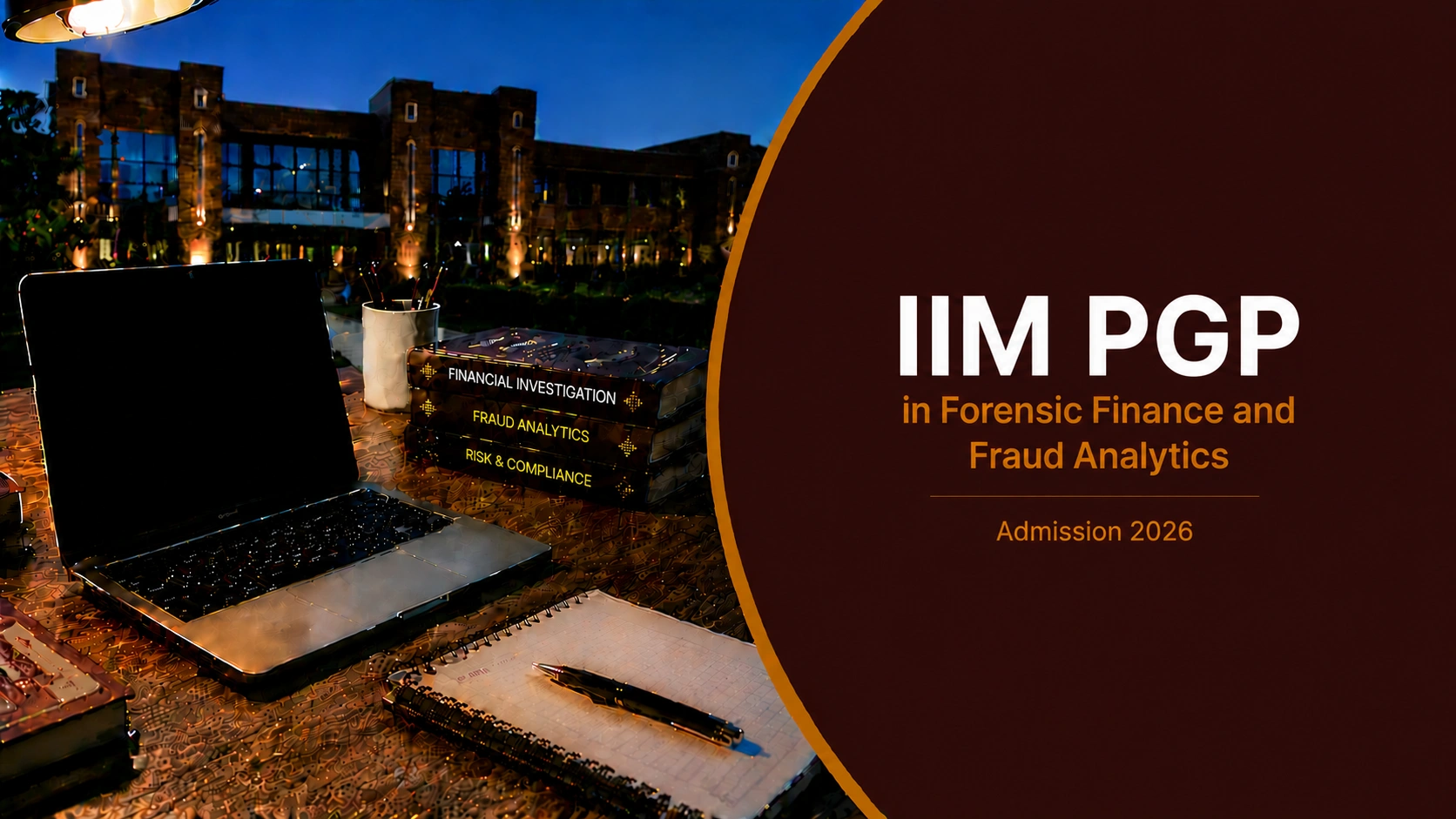
Learn to Follow the Money, Detect the Truth, and Protect Organizations.
Learn to Follow the Money, Detect the Truth, and Protect Organizations.
Most financial transactions happen quietly. Invoices get processed. Payments move across accounts. Budgets are approved. Investments are evaluated. Contracts are signed. Businesses operate. Trust allows the entire system to function.
But what happens when that trust is broken? What happens when numbers are manipulated? When financial statements hide the truth? When cybercriminals exploit weaknesses? When employees misuse authority? When fraud quietly grows beneath the surface of an otherwise successful organization?
The consequences can be devastating.
In an increasingly digital and interconnected world, financial fraud has become more sophisticated than ever before. Traditional auditing methods alone are often insufficient. Organizations require professionals who can investigate anomalies, uncover hidden patterns, analyze financial evidence, and identify misconduct before it escalates.
The Post Graduate Programme in Forensic Finance and Fraud Analytics prepares professionals to meet this challenge. It combines finance, investigative techniques, analytics, governance, and technology to develop specialists capable of protecting organizations from financial wrongdoing.
Whether you aspire to build a career in fraud investigations, forensic consulting, compliance, risk advisory, financial intelligence, or corporate governance, this programme provides the knowledge and practical skills required in one of the fastest-growing areas of modern business.
Because numbers tell stories. And sometimes, they reveal truths others hope remain hidden.
Financial fraud is no longer limited to isolated incidents involving forged signatures or manipulated invoices. Today's fraud schemes are increasingly sophisticated. They exploit technology, cross international boundaries, leverage digital channels, and often remain undetected for extended periods.
Organizations therefore require professionals capable of thinking critically and investigating thoroughly. The PGP in Forensic Finance and Fraud Analytics bridges the gap between traditional financial expertise and investigative capability.
The programme explores both prevention and response. Participants study how organizations build resilient systems while also learning how investigations unfold once misconduct is suspected.
One of the programme's greatest strengths lies in its interdisciplinary nature. Finance professionals strengthen investigative capabilities. Auditors deepen analytical skills. Risk professionals improve fraud prevention strategies. Legal specialists gain financial insight. Consultants expand advisory expertise.
Because protecting trust requires more than technical knowledge.
It requires curiosity, skepticism, integrity, and the courage to ask difficult questions.
The global business environment continues evolving rapidly. Fraud risks evolve alongside it.
The curriculum combines financial knowledge, investigative techniques, analytics, and governance principles. Participants focus heavily on practical application.
Students generally explore:
These subjects establish essential foundations.
Participants learn:
These capabilities strengthen investigative effectiveness.
Students explore:
These modules address emerging risks.
Participants examine:
Technology increasingly shapes investigations.
Students strengthen capabilities related to:
Strong governance reduces vulnerability.
Forensic expertise develops through application. Participants engage through:
The emphasis remains practical and action-oriented.
The programme welcomes professionals from diverse backgrounds connected to finance, governance, and investigations.
| Criteria | Requirement |
|---|---|
| Educational Qualification | Applicants should possess a recognized bachelor's degree. Academic requirements vary by institution. |
| Professional Background | Participants often include Chartered Accountants, auditors, bankers, compliance specialists, risk professionals, consultants, finance managers, and legal professionals. However, motivated professionals from other backgrounds may also be eligible. |
| Selection Process | Institutes generally evaluate academic credentials, professional experience, career aspirations, analytical capability, and overall profile strength. |
The emphasis remains on readiness to contribute meaningfully to investigative learning environments.
Known for executive education and specialized programmes.
Strong focus on governance and leadership.
Contemporary approach to professional education.
Recognized for analytical rigor and finance expertise.
Growing emphasis on ethical leadership and governance.
Professionals often compare programmes based on curriculum depth, investigative focus, faculty expertise, peer quality, and alignment with long-term career goals.
In today's business environment, fraud has become more sophisticated than ever before. It no longer resembles the traditional image of a forged cheque or an employee stealing cash from a register. Modern financial crimes involve complex transactions, digital manipulation, money laundering networks, cyber-enabled fraud schemes, procurement irregularities, insider collusion, and the misuse of emerging technologies.
The financial impact is enormous. Organizations lose billions of dollars globally every year due to fraud and financial misconduct. However, the damage often extends beyond financial losses.
As these risks continue to evolve, organizations increasingly seek professionals who can investigate suspicious activities, identify vulnerabilities, and strengthen preventive systems. This is where Forensic Finance and Fraud Analytics professionals create tremendous value. They protect businesses, strengthen governance, support justice, and ensure accountability.
Because behind every fraud case lies an important question. Could this have been prevented?
And increasingly, organizations are investing in professionals who know how to answer that question.
Forensic Accountants investigate financial irregularities and uncover hidden evidence. Responsibilities include examining financial records, tracing transactions, investigating accounting anomalies, supporting litigation processes, preparing investigation reports, and providing expert testimony.
Consultants help organizations identify and mitigate fraud risks. Responsibilities include fraud risk assessments, control evaluations, process reviews, policy recommendations, awareness initiatives, and fraud prevention strategies.
Financial Crime Analysts monitor transactions and identify suspicious activities. Responsibilities include transaction analysis, suspicious activity investigations, pattern recognition, reporting, escalation support, and compliance coordination.
Forensic Auditors strengthen organizational accountability. Responsibilities include audit investigations, evidence collection, control testing, documentation reviews, fraud examinations, and investigation support.
Compliance professionals help organizations adhere to regulatory expectations. Responsibilities include policy development, compliance monitoring, regulatory reporting, employee training, risk assessments, and control oversight.
AML specialists support financial integrity. Responsibilities include KYC reviews, AML investigations, transaction monitoring, regulatory reporting, escalation procedures, and control evaluations.
Investigators respond to allegations of misconduct. Responsibilities include case planning, witness interviews, evidence review, investigation documentation, stakeholder communication, and resolution recommendations.
Risk professionals strengthen organizational resilience. Responsibilities include enterprise risk assessments, governance reviews, control evaluations, risk reporting, and strategic recommendations.
Demand for fraud and forensic professionals has expanded significantly. Several factors contribute to this growth.
As a result, organizations increasingly invest in prevention rather than reacting after losses occur. Forensic expertise is now valued across industries. Banks strengthen financial crime teams. Consulting firms expand forensic advisory practices. Technology companies monitor emerging threats. Healthcare organizations strengthen compliance functions. Manufacturing firms improve internal controls. Government institutions enhance investigative capabilities.
Many professionals pursue this programme to deepen specialization within existing careers. Others transition into entirely new domains. Finance professionals move into investigations. Auditors develop forensic expertise. Risk specialists expand advisory capabilities. Compliance leaders strengthen governance knowledge.
Participants frequently report career progression and salary growth ranging between 20 percent and 50 percent over time. For many, the programme becomes a gateway into highly respected and intellectually stimulating career pathways.
Forensic Finance professionals contribute across multiple sectors.
Deloitte Forensic, EY Forensics, KPMG Forensic, PwC, Grant Thornton, and BDO. These organizations regularly recruit investigative talent.
HDFC Bank, ICICI Bank, Axis Bank, HSBC, Standard Chartered, JPMorgan Chase, and American Express. Financial institutions invest heavily in fraud prevention capabilities.
Financial intelligence units, compliance divisions, risk oversight functions, and regulatory reporting teams. Governance expectations continue increasing.
Paytm, PhonePe, Razorpay, and FinTech startups. Digital businesses increasingly monitor transaction risks.
Tata Group, Reliance Industries, Aditya Birla Group, and Mahindra Group. Large organizations strengthen internal investigation functions.
Dispute advisory practices, litigation support teams, and corporate investigation units. Cross-functional expertise remains highly valued.
Compensation within forensic finance depends on professional experience, industry specialization, certifications, leadership responsibilities, geographic location, and investigative expertise.
Professionals who combine finance expertise with investigative capabilities often enjoy strong long-term career prospects. Their work remains highly specialized and increasingly essential.
Executive programmes in forensic finance offer a strong balance between affordability and specialization. Participants continue earning while strengthening expertise.
The total investment generally depends on the institute. The fee structure often includes:
Participants may explore:
Organizations increasingly encourage specialization in risk-related domains.
Return on investment extends beyond compensation. Participants gain:
For many professionals, the greatest return lies in becoming trusted advisors capable of protecting organizations from significant harm.
Forensic Finance and Fraud Analytics remains one of the most future-relevant executive education investments available today.
Learn how fraud schemes operate and how they are detected.
Interpret evidence and identify anomalies effectively.
Develop capabilities valued across industries.
Continue earning while enhancing expertise.
Support stronger organizational resilience.
Enhance professional visibility and credibility.
Investigations, consulting, compliance, and advisory opportunities await.
Learn alongside experienced professionals from multiple sectors.
I realised fraud prevention is not just about controls. It is about understanding behaviour, incentives, and vulnerabilities.
The programme helped me connect regulations with practical business realities. I became more confident handling complex situations.
The case studies transformed the way I approached investigations. Every anomaly became a question worth exploring.
I entered the programme to deepen my compliance expertise. I left with an entirely new appreciation for investigative thinking.
These experiences reveal an important truth.
Fraud investigation is not about suspicion. It is about seeking facts with integrity and objectivity.
This programme may be an excellent fit if you:
You do not need prior forensic experience. Curiosity, integrity, and critical thinking often matter most.
Students interested in Forensic Finance and Fraud Analytics also explore:



Choosing executive education is ultimately about choosing the problems you want to solve.
And for those who believe that integrity, accountability, and truth are worth protecting, Forensic Finance and Fraud Analytics remains one of the most powerful journeys an IIM education can offer.
Explore the leading IIMs offering this Forensic Finance and Fraud Analytics programme, and get a quick overview of their fees, placements, rankings, and eligibility to help you choose the right fit.




Trust is one of the most valuable assets any organization possesses. It takes years to build. And moments to destroy. Forensic Finance and Fraud Analytics prepares professionals to protect that trust. It transforms financial expertise into investigative capability, suspicion into evidence, and risk into resilience. If you aspire to build a career defined by integrity, analytical excellence, and meaningful impact, the PGP in Forensic Finance and Fraud Analytics could be one of the most rewarding investments you make. Speak with our admission experts today, evaluate your profile, and discover which IIM programme aligns with your ambitions. Because in a world where financial complexity continues to grow, the professionals who uncover the truth will always matter.
👋 Thinking about applying?
Our counsellors are here to help you pick the right programme. Drop us a query!