
IIMs Courses
India's MBA Discovery

Learn to Make Better Decisions in a World Driven by Data.
Learn to Make Better Decisions in a World Driven by Data.
Every second, millions of decisions are made across the world. A retailer decides which products to stock. A bank evaluates whether to approve a loan. A hospital predicts patient demand. A streaming platform recommends what you should watch next.
At first glance, these decisions appear very different. But beneath the surface, they share one thing in common. They are powered by data.
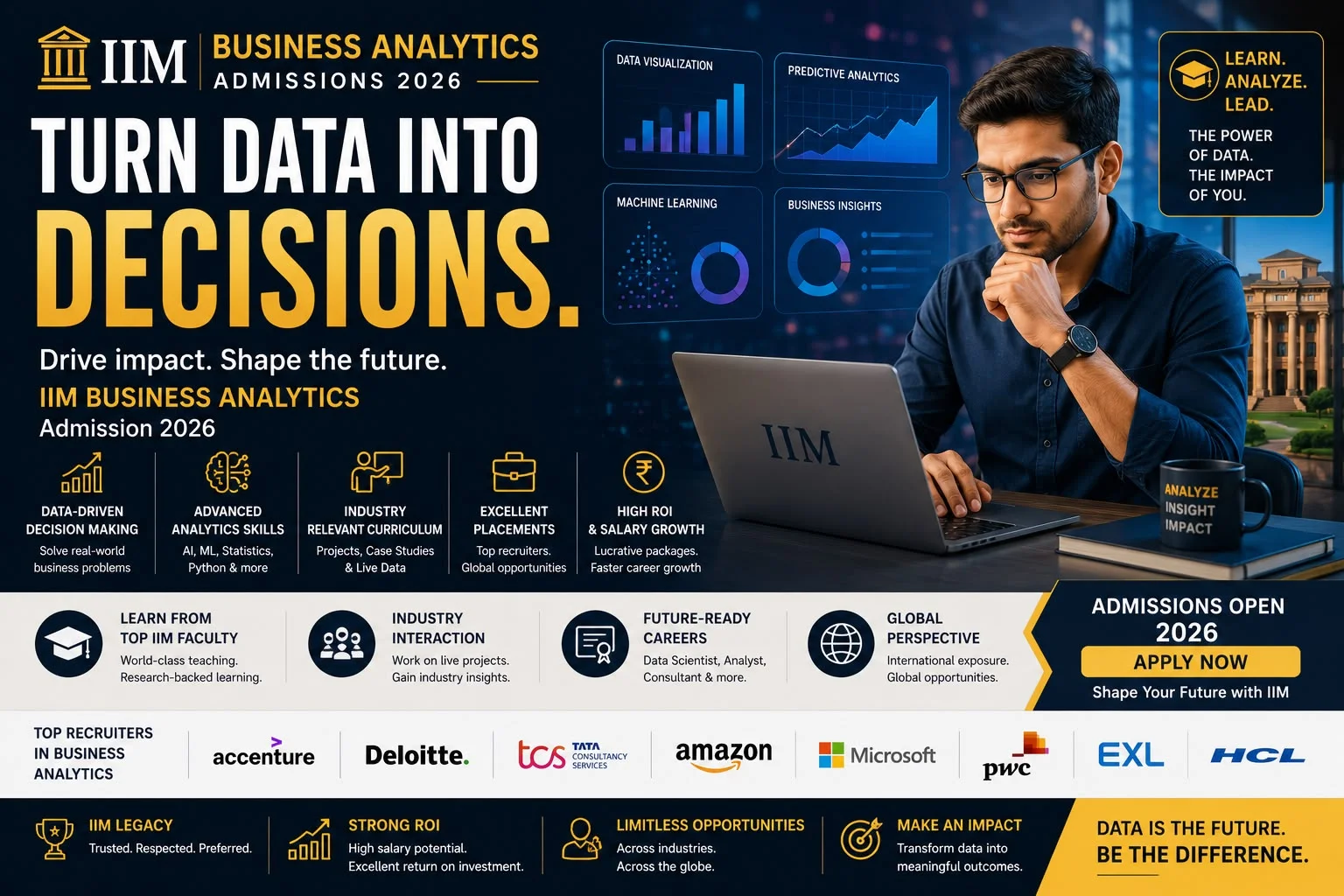
This is where Business Analytics emerges as one of the most valuable capabilities of the modern economy. The Post Graduate Certificate in Business Analytics prepares professionals to bridge the gap between data and decision-making.
Because the future will not belong to people who have the most data. It will belong to those who know what to do with it.
Business Analytics has transformed from a niche capability into a strategic necessity. Organizations no longer rely solely on instinct. They increasingly depend on evidence. Executives expect teams to justify decisions through analysis. Customers demand personalized experiences. Investors seek predictive insights.
Importantly, Business Analytics is not limited to coding or advanced mathematics. It is fundamentally about solving business problems.
One of the programme's greatest strengths lies in its accessibility. Professionals from diverse backgrounds often succeed. Engineers leverage analytical strengths. Marketers deepen customer understanding. Finance professionals strengthen forecasting capabilities.
The result is a versatile qualification relevant across industries. Because in today's environment, every leader benefits from analytical thinking.
The modern economy generates unprecedented amounts of information. Organizations capable of using it effectively gain significant advantages.
The curriculum combines analytical techniques with business applications. Participants focus not merely on tools, but on decision-making.
Students generally explore:
Participants learn:
Students may explore:
Analytics becomes meaningful when applied effectively. Participants examine applications within:
Depending on programme design, participants may gain exposure to:
Business Analytics develops through application. Participants engage through:
These experiences strengthen confidence and practical capability.
The programme welcomes professionals from diverse backgrounds.
| Criteria | Requirement |
|---|---|
| Educational Qualification | Applicants should possess a recognized bachelor's degree. Minimum academic requirements vary by institution. |
| Work Experience | Many programmes prefer professionals with work experience. However, early-career candidates may also be eligible. |
| Selection Process | Institutes generally evaluate academic credentials, professional experience, career aspirations, overall profile strength, and leadership potential. |
Institutes generally evaluate:
The emphasis remains on readiness to benefit from analytical learning.
Strong reputation for analytical excellence.
Known for quantitative rigor.
Contemporary approach to executive learning.
Balanced management and analytical education.
Accessible executive learning opportunities.
Professionals often compare programmes based on flexibility, faculty expertise, peer profiles, and alignment with career objectives.
One of the biggest reasons professionals choose Business Analytics today is because it offers something extremely rare in the modern job market — versatility. Industries may change. Technologies may evolve. Business models may transform. But the ability to understand information and make better decisions remains valuable everywhere.
Because analytics is no longer a specialized function. It has become a leadership capability.
Business Analysts identify opportunities for improvement through data interpretation and stakeholder collaboration. Responsibilities include data analysis, requirements gathering, performance tracking, process improvement, dashboard development, and business recommendations.
Consultants help organizations solve business challenges using analytical frameworks. Responsibilities include client engagement, data-driven recommendations, business assessments, strategy development, and performance analysis.
Product Analysts support decision-making related to digital products and customer experiences. Responsibilities include user behaviour analysis, feature evaluations, experiment analysis, performance reporting, and product recommendations.
Marketing professionals increasingly rely on evidence to guide investments. Responsibilities include campaign measurement, customer segmentation, attribution analysis, consumer insights, and performance optimization.
Analytics strengthens forecasting and financial planning. Responsibilities include trend analysis, budget forecasting, risk assessments, scenario modelling, and performance reporting.
Operations professionals improve efficiency and reduce waste. Responsibilities include capacity planning, process evaluations, inventory analysis, performance monitoring, and operational optimization.
People decisions increasingly depend on evidence. Responsibilities include workforce planning, attrition analysis, employee engagement studies, performance evaluations, and talent insights.
Customer-centric organizations invest heavily in understanding behaviour. Responsibilities include consumer research, trend identification, segmentation, behavioural analysis, and recommendation development.
Business Analytics has become one of the most transferable capabilities in the job market. Unlike niche specializations limited to a single industry, analytics creates opportunities across sectors.
Many participants pursue certificate programmes not to change careers entirely but to strengthen existing ones. Managers become more data-driven. Marketers improve campaign effectiveness. Finance professionals sharpen forecasting. Entrepreneurs make better decisions.
Average salary growth reported by participants often ranges between 20 percent and 50 percent over time, depending on role transitions, experience levels, industry conditions, and organizational opportunities. For many professionals, the programme becomes a catalyst for accelerated career progression.
Business Analytics professionals contribute across virtually every sector of the economy.
Google, Amazon, Microsoft, Infosys, TCS, Wipro, Cognizant, and Capgemini. Technology organizations increasingly prioritize analytical capabilities.
Deloitte, EY, KPMG, PwC, Accenture, McKinsey Digital, and BCG. Consultants leverage analytics to solve complex client problems.
HDFC Bank, ICICI Bank, Axis Bank, American Express, JPMorgan Chase, and HSBC. Financial institutions continue investing heavily in analytical talent.
Flipkart, Amazon, Nykaa, Meesho, and Reliance Retail. Consumer businesses rely on insights to drive growth.
Apollo Hospitals, Fortis Healthcare, pharmaceutical companies, and health technology firms. Analytics increasingly influences healthcare outcomes.
Tata Group, Mahindra, Aditya Birla Group, and Larsen and Toubro. Operational excellence depends increasingly on data.
Compensation within analytics depends on multiple factors including prior experience, industry, functional specialization, technical proficiency, leadership responsibilities, and geographic location.
While salary growth varies, analytical capabilities consistently enhance long-term employability.
One of the strongest advantages of certificate programmes is their relatively lower investment compared with full-time degree programmes.
The fee structure often includes:
Participants may explore:
Many organizations actively support employee upskilling initiatives.
Return on investment extends beyond immediate salary increases. Participants gain:
For many professionals, the ability to remain competitive in an increasingly data-driven economy becomes the programme's greatest return.
Business Analytics remains one of the most practical executive learning investments available today.
Analytical thinking remains valuable across industries.
Continue earning while strengthening capabilities.
Focus on real business problems.
Analytics supports transitions across functions.
Move beyond intuition toward evidence-based leadership.
Enhance credibility and professional visibility.
Apply analytics across marketing, finance, operations, and HR.
Learn alongside professionals from diverse backgrounds.
I always relied on experience to make decisions. The programme taught me how to validate intuition using evidence, which transformed the way I approached leadership.
Understanding customer data helped me improve campaign performance significantly. The learning felt immediately applicable.
I did not want to become a data scientist. I wanted to become a better problem solver. This programme helped me bridge that gap.
The biggest shift was learning to ask better questions. Analytics is not just about numbers. It is about curiosity and clarity.
These experiences highlight an important truth.
Business Analytics is not about becoming obsessed with data. It is about becoming more thoughtful in the decisions we make.
This programme may be an excellent fit if you:
You do not need to be a programmer or statistician to succeed. Curiosity, discipline, and a willingness to learn matter far more.
Students interested in Business Analytics also explore:


Choosing executive education is ultimately about choosing the capabilities you want to strengthen.
And for those who believe better decisions create better outcomes, Business Analytics remains one of the most powerful journeys an IIM education can offer.
Explore the leading IIMs offering this Business Analytics programme, and get a quick overview of their fees, placements, rankings, and eligibility to help you choose the right fit.






Data is abundant. Insight is rare. The organizations that thrive tomorrow will not necessarily be those with the largest databases. They will be those capable of asking meaningful questions, interpreting evidence thoughtfully, and acting with confidence. Business Analytics prepares professionals for that future. Speak with our admission experts today, evaluate your profile, and discover which IIM programme aligns with your ambitions.
👋 Thinking about applying?
Our counsellors are here to help you pick the right programme. Drop us a query!